Water utilities
A Low-Cost Data Logger for Remote Water Plants
A standalone embedded logger that records well levels and tank pressures at unattended plants, cheap enough to put at every site and simple enough for field staff.
The problem
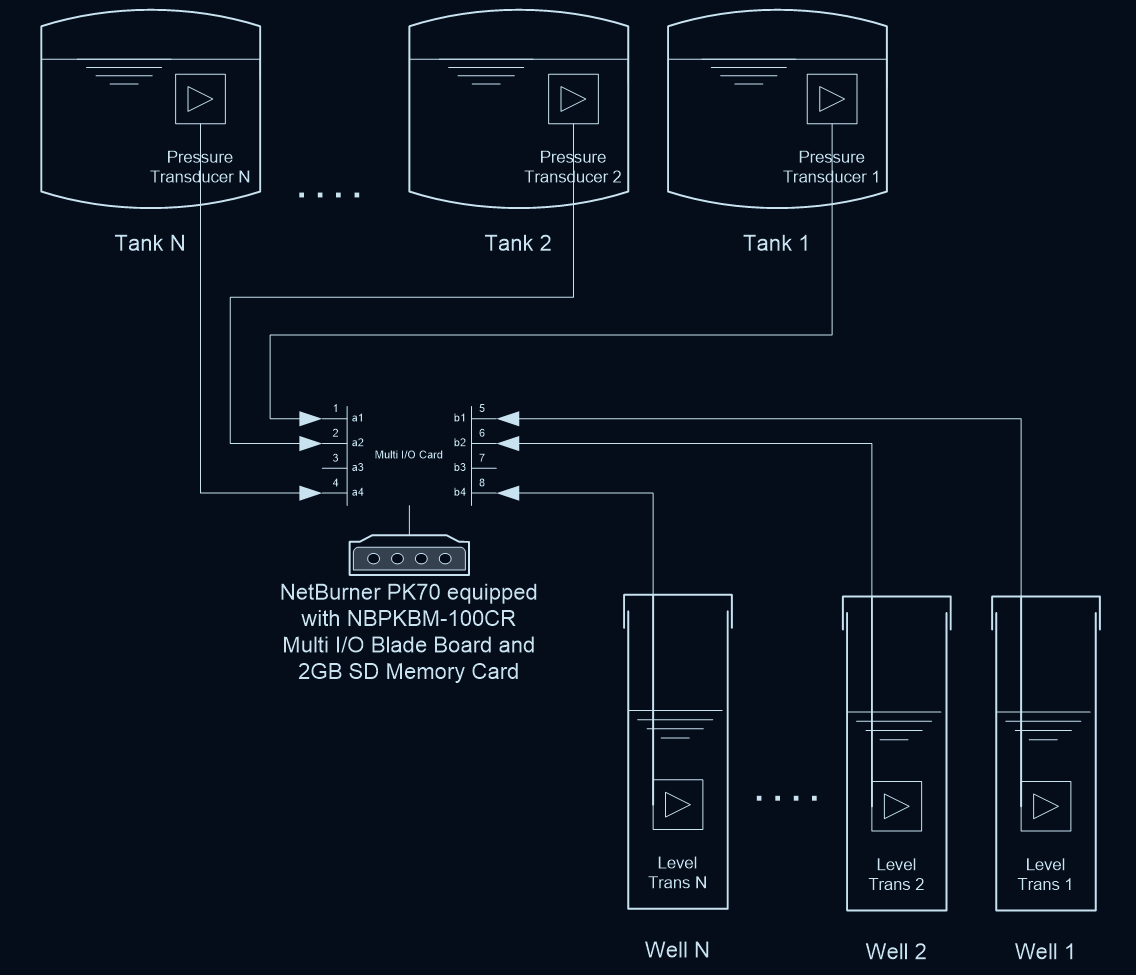
A water utility runs plants at remote sites, each with one or more wells and storage tanks. Between visits, nobody could see how well levels and tank pressures were changing.
They needed a logger cheap enough to install at every plant, and simple enough that field staff could look after it without an engineer on site.
What we built
A standalone logger, written in C for a small embedded controller. It reads up to eight level and pressure sensors and records them in real units (feet of water, pounds of pressure) on a removable SD card. Resolution works out to about an inch, even on a 300-foot well. At a reading every ten seconds, one card holds years of data.
The same software at every plant. Each site’s setup lives in a plain text file on the card: how often to record, which sensors are connected, and how to scale each one. A new plant needs a new file, not new code.
Built for the field. Data is split into one file per day, so a damaged file never costs more than a day. Before swapping the card, the technician flips a switch that tells the logger to finish writing and stop. Two status lights show every state: logging, safe to remove, missing card, or missing setup file.
No data lost to a power outage. The controller has no battery-backed clock, so a restart could have overwritten past data. Instead, the logger detects existing files and starts a fresh set after every restart.
A spreadsheet that rebuilds the timeline. The technician enters the time the card was pulled, and an Excel workbook calculates the real date and time of every reading, laying the data out one sheet per day, ready to analyze.
We also delivered an installation and user manual, wiring diagrams, and a one-page card-swap guide for field staff.
The result
One design served every plant. After the first unit, each additional plant needed only a few hundred dollars in hardware plus a setup file, giving the utility visibility at sites it had previously checked only by visiting.
- Embedded C
- NetBurner embedded controller
- 4-20 mA instrumentation
- SD card storage
- Excel VBA