Sports safety devices
Proving a Wearable Impact Sensor Against a Lab Reference
Test software for a drop rig that checks a wearable impact sensor against a precision reference accelerometer, impact by impact, with the head-injury measures computed for both side by side.
The problem
A startup developing a wearable impact sensor for sports needed to prove that what their device reported matched what actually happened in an impact. The only way to know was to drop an instrumented test head again and again and compare the device’s reading with a precision laboratory accelerometer, impact by impact.
Doing that by hand meant juggling two data sources with different formats and time scales, then calculating the injury measures for each.
What we built
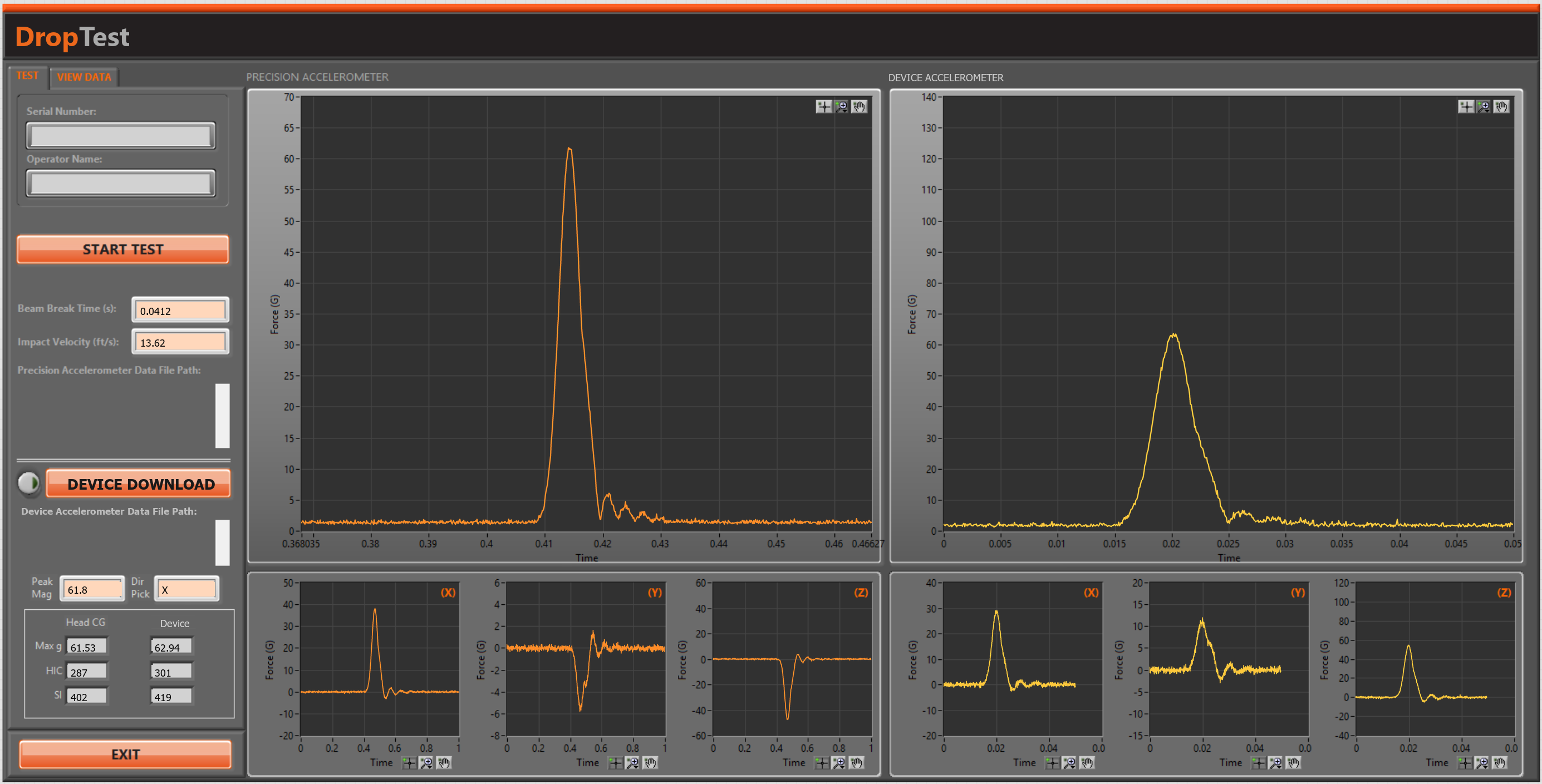
One test, both readings. The operator enters the device’s serial number and starts a test. The application captures the precision accelerometer at the test head’s center of gravity during the drop, times the fall with a light beam to calculate the impact velocity, then downloads the impact the device itself recorded.
Side by side, axis by axis. Both readings appear next to each other: overall force, plus the X, Y, and Z components, so engineers can see at a glance whether the device caught the same impact, at the same strength, in the same direction.
The numbers that matter. For both the reference and the device, the application calculates peak force, the Head Injury Criterion (HIC), and the Severity Index (SI), the standard measures of how dangerous an impact is.
Every test kept. Each result is saved with its serial number and operator, and a separate screen reloads any past test for review.
Kept current. When the device moved to a new, standardized data format, we updated the download and parsing so the comparison kept working, with the device’s extra header information made available for analysis.
The result
The startup could test its sensor against a trusted reference quickly and repeatably, with every comparison documented, which is the kind of evidence a safety device needs.
- LabVIEW
- High-rate data acquisition
- Precision accelerometers
- Device data download
- XML parsing
- Impact analysis